
Want to know exactly how many times your keyword shows up in your content? A Zuhio keyword count checker helps you track keyword frequency, spot over-stuffing, and keep your writing search-friendly. It’s a simple way to write smarter, not harder!
Let me walk you through what this tool does, why it matters, and how you can use keyword counting to boost your content. Grab a coffee — this is going to be fun and genuinely useful.
What Is a Zuhio Keyword Count Checker?
A Zuhio keyword count checker is a tool that scans your text and counts how often specific words or phrases appear. It shows you keyword frequency and density at a glance. Think of it as a word detective for your content!
Here’s the deal. When you write blog posts, product pages, or web copy, you naturally want your target keywords to show up. But there’s a sweet spot. Too few, and search engines might miss your topic. Too many, and you risk looking spammy.
A keyword count checker takes the guesswork out. Instead of squinting at your screen and counting “SEO” twelve times by hand (been there, it’s exhausting!), the tool does it instantly. You get clean numbers and clear insights.
Why Does Keyword Count Actually Matter for SEO?
Keyword count matters because it signals relevance to search engines without tipping into spam. Google wants natural writing, not robotic repetition. The right balance helps both readers and rankings.
Google has been clear about this for years. In its own Helpful Content guidance, Google says you should “write content that’s primarily for people, not search engines.” Stuffing keywords goes against that idea completely.
In fact, Google spam policies explicitly call out “keyword stuffing” as a practice that can hurt your rankings. So counting your keywords isn’t about hitting a magic number — it’s about staying natural and avoiding red flags.
Here’s a fun fact: way back in 2009, Google publicly stated that keyword density is not a ranking factor people should obsess over. Yet smart writers still track it, because awareness keeps your writing balanced and honest.
What Is Keyword Density, and What’s the Ideal Range?
Keyword density is the percentage of times a keyword appears compared to your total word count. Most SEO experts suggest keeping it around 1–2%. There’s no official rule, but this range feels natural to readers.
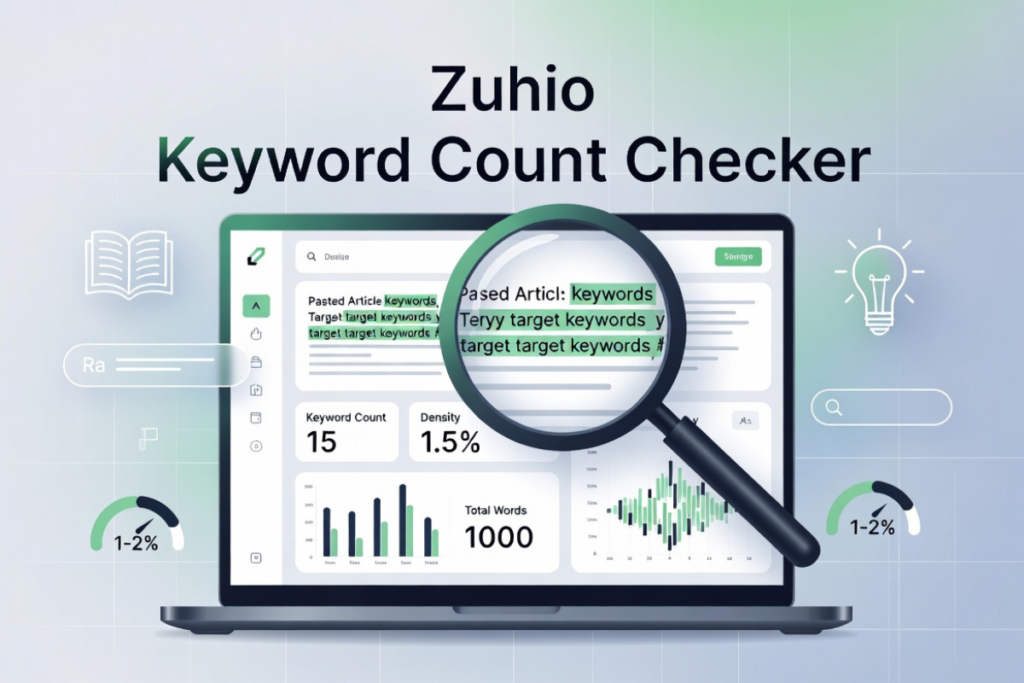
The math is easy. If your article has 1,000 words and your keyword shows up 15 times, your density is 1.5%. A good checker calculates this for you automatically.
Why care about this number? Because readers notice repetition. If “best running shoes” pops up in every other sentence, the writing feels clunky. A density check keeps your tone smooth and conversational.
Industry sources like Yoast and Semrush both recommend prioritizing readability over rigid density targets. The percentage is a guideline, not a law. Use it to stay grounded, not to chase a perfect score.
How Does a Zuhio Keyword Count Checker Work?
It works by scanning your pasted text and matching it against the keywords you enter. Then it displays counts, frequency, and density in seconds. No spreadsheets, no manual tallying — just instant clarity!
The process is delightfully simple:
- Paste your content into the tool text box.
- Enter your target keyword or phrase you want to track.
- Hit the check button and watch the results appear.
- Review your numbers — count, density, and total word count.
Most tools also count total words and characters along the way. That’s handy, since Google John Mueller has confirmed word count alone is not a ranking factor. Quality beats quantity every time!
I remember the first time I used a keyword counter on an old blog post. I’d accidentally used “freelance writing” 28 times in 800 words. Yikes! No wonder it read like a broken record. The tool caught what my tired eyes missed.
When Should You Use a Keyword Count Checker?
Use it during editing, before publishing, and when refreshing old content. It’s most helpful at the polishing stage, after your draft is written. That’s when you fine-tune for balance.
Don’t count keywords while drafting your first version. Seriously — just write naturally and let the ideas flow! Counting too early can make your sentences stiff and forced.
Once your draft is done, run it through the checker. This is your moment to catch accidental repetition or thin keyword usage. It’s like proofreading, but for SEO health.
It’s also great for content audits. If you’re updating a post from two years ago, a quick check shows whether your keyword strategy still makes sense. Google research shows fresh, updated content often performs better in search.
What Are the Benefits of Using a Keyword Count Tool?
The biggest benefits are saving time, avoiding keyword stuffing, and improving content quality. You write faster and edit smarter. Plus, you protect your site from spammy patterns that hurt rankings.
Here’s what you gain:
- Speed: Counting by hand wastes precious time. The tool does it instantly.
- Accuracy: Humans miscount. Tools don’t get tired or distracted.
- Balance: You spot over-optimization before Google does.
- Confidence: You publish knowing your content reads naturally.
There’s also a peace-of-mind factor. According to Statista, there were over 1.1 billion websites in existence by 2023. Standing out in that crowd means publishing clean, reader-first content. A keyword checker helps you do exactly that.
How Do You Use Keyword Counts to Improve Content?
Use your counts to guide gentle edits, not robotic rewrites. If a keyword appears too often, swap some uses for synonyms. If it’s too rare, add it naturally where it fits. Easy!
Let’s say your keyword shows up 25 times in a short post. That’s a sign to relax. Replace a few mentions with related phrases — search engines love semantic variety anyway.
Google algorithms have grown incredibly smart. With systems like BERT, introduced in 2019, Google understands context and natural language far better than before. So writing for humans genuinely helps your SEO.
Here’s my favorite tip: read your content aloud after checking it. If it sounds like a normal human talking, you’re golden. If it sounds like a parrot stuck on one word, trim those keywords down.
Is Keyword Counting Still Relevant in the Age of AI Search?
Yes, it absolutely is! AI search engines still rely on understanding topics and relevance. Keyword awareness helps your content stay clear, focused, and topically rich. It just isn’t about cramming anymore.
AI-powered search tools, like Google AI Overviews, pull from content that clearly answers questions. Clear keyword usage signals what your page is about, which helps these systems understand and surface your content.
That said, the focus has shifted toward topics over single keywords. Modern SEO loves natural language, related terms, and genuine helpfulness. A keyword counter fits this perfectly — it keeps you balanced without going overboard.
Think of it this way: AI doesn’t reward repetition, but it does reward clarity. A quick count keeps your message sharp and your topic obvious. That’s a win for old-school search and shiny new AI engines!
What Should You Avoid When Counting Keywords?
Avoid obsessing over exact percentages, ignoring readability, and stuffing keywords to hit a target. These habits backfire fast. The goal is helpful content, not a numbers game.
Don’t force keywords into awkward spots. If a sentence feels twisted just to fit a phrase, rewrite it. Readers — and Google — can tell the difference instantly.
Also, skip the temptation to chase competitors’ exact counts. Every piece of content is different. Your blog post doesn’t need the same density as someone else product page.
Quick Tips for Smart Keyword Usage
Here are some handy reminders to keep your content sharp and search-friendly:
- Write first, count later. Let your ideas breathe before optimizing.
- Aim for natural flow. If it reads well aloud, you’re on track.
- Use synonyms freely. Variety strengthens your topic coverage.
- Place keywords in key spots. Titles, headings, and intros matter most.
- Check, then trust yourself. The tool guides you, but your judgment leads.
Frequently Asked Questions
What is a Zuhio keyword count checker used for?
It’s used to count how many times specific keywords appear in your text. This helps you track keyword density and avoid over-optimization. You get instant numbers without manual counting, making your editing faster and smarter.
Is keyword density a Google ranking factor?
No, keyword density is not a direct ranking factor. Google confirmed this years ago and continues to prioritize helpful, natural content. Still, tracking density helps you write balanced copy that reads well for humans.
What is the ideal keyword density for a blog post?
Most experts suggest around 1–2%, but there’s no official rule. Focus on natural writing instead of a strict percentage. If your keyword fits smoothly throughout your content, you’re in great shape.
Does word count affect SEO rankings?
Word count alone doesn’t affect rankings, according to Google John Mueller. What matters is whether your content fully answers the reader question. Long content can help, but only when it’s genuinely useful.
Can a keyword count checker help with AI search?
Yes! Keyword awareness keeps your content clear and topically focused. AI search tools reward content that clearly answers questions. A count checker helps you stay sharp without stuffing keywords unnaturally.
How often should I check my keyword counts?
Check during editing and before publishing, plus when refreshing old posts. Avoid checking during your first draft. Counting too early can make your writing feel stiff and forced.
Final Thoughts
A Zuhio keyword count checker is a small tool with a big impact. It saves you time, protects your content from keyword stuffing, and keeps your writing natural and reader-friendly. What’s not to love?
Remember, the goal isn’t perfect numbers — it’s helpful, honest content that serves your readers first. Use the tool as a guide, trust your instincts, and keep writing for people. Google, AI search, and your audience will thank you for it!
So go ahead, paste in your draft, run a quick check, and publish with confidence. Happy writing!
Read More: Moz vs Ahrefs: Which SEO Tool Is Right for You in 2026?