
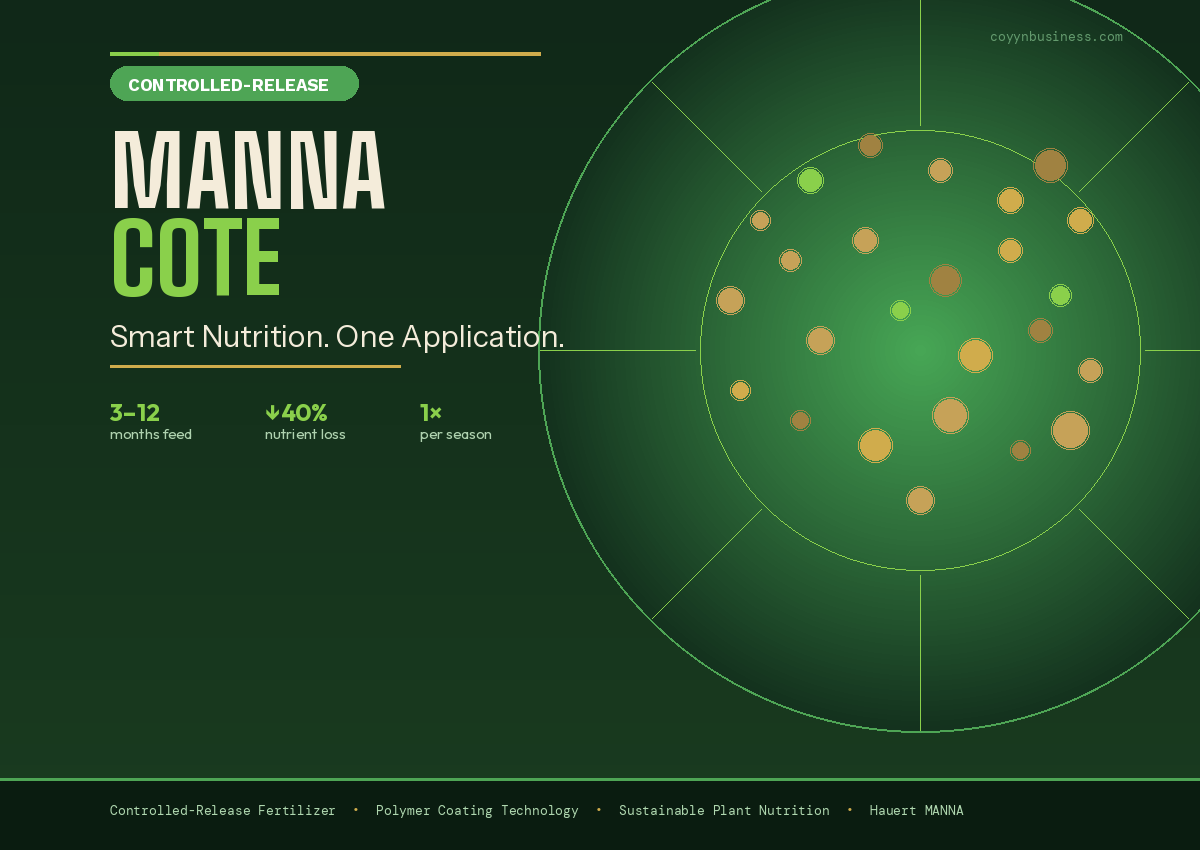
If you’ve ever watched a beautiful garden wilt despite regular feeding, you know the frustration of conventional fertilizers. They spike nutrients fast, then leave your plants starving—all while polluting nearby waterways. Mannacote, a high-performance controlled-release fertilizer (CRF), is changing that story for growers everywhere.
Whether you’re a home gardener tending tomatoes on a weekend or a commercial farmer managing hectares of fruit trees, Mannacote’s precision nutrient delivery system offers a smarter, more sustainable path to plant health. Let’s dig into exactly what it is, how it works, and why so many growers are switching.
What Is Mannacote?
Mannacote is a controlled-release fertilizer developed by Hauert MANNA, a Swiss company with over 350 years of expertise in plant nutrition. It comes in the form of small, coated granules—often called “perls”—each packed with a balanced blend of nitrogen (N), phosphorus (P), potassium (K), and essential micronutrients like magnesium, iron, and manganese.
Unlike traditional fertilizers that dissolve instantly when wet, Mannacote’s polymer-coated granules release nutrients gradually, over a period ranging from 3 to 12 months. This slow-release mechanism eliminates the familiar “feast or famine” cycle that plagues conventional feeding programs, giving your plants a steady, predictable stream of nutrition across the entire growing season.
How Does Mannacote’s Coating Technology Work?
The science behind Mannacote is elegantly simple. Each granule is encased in a semi-permeable polymer coating. Once you apply Mannacote to the soil and water it in, moisture penetrates the microscopic pores of the shell, dissolving the NPK concentrate inside into a liquid form. That liquid then diffuses outward slowly into the root zone.
What makes this process truly remarkable is that it is primarily controlled by soil temperature, not just moisture. As temperatures rise and plant metabolic activity accelerates, the release rate increases accordingly. When the weather cools and growth slows, release slows too. This temperature-responsive mechanism means nutrients align almost perfectly with your plant’s actual hunger cycle—a feat no conventional fertilizer can match.
Key Benefits of Using Mannacote
1. Reduced Nutrient Leaching
Traditional fertilizers are notoriously “leaky.” Heavy rain or irrigation can wash a significant portion of nitrogen out of the root zone and into groundwater or local waterways. Because Mannacote releases nutrients slowly, plants have time to absorb nearly every molecule. Research suggests slow-release fertilizers can reduce nutrient loss by up to 40% compared to quick-release alternatives, making every dollar you spend go further.
2. Fewer Applications, Lower Labor Costs
One of Mannacote’s most practical advantages is its longevity. A single application can feed plants for 3 to 12 months, depending on the formulation and environmental conditions. For commercial operations, this “one and done” approach frees up labor for other vital tasks and drastically reduces the wear on application machinery. Home gardeners benefit too—less time fertilizing means more time actually enjoying the garden.
3. Safer for Plants and Soil
Conventional fertilizers can burn roots if overapplied due to a high salt index. Mannacote releases nutrients at a pace that plants can safely absorb, making root burn an extremely rare concern. Over time, this gentler approach also supports beneficial soil microorganisms, earthworms, and the organic matter structure that keeps your growing medium productive season after season.
4. Environmental Responsibility
Mannacote’s low-leach profile reduces nitrate pollution in rivers and groundwater—a growing regulatory concern in many regions. By minimizing runoff, it also protects local aquatic ecosystems from nutrient overload and algae blooms. For growers who want their practices to align with sustainable agriculture principles, Mannacote’s reduced environmental footprint is a compelling advantage.
Where Can You Use Mannacote?
Mannacote’s versatility is one of its greatest strengths. It is equally at home in multiple growing contexts:
Home Vegetable Gardens: Tomatoes, peppers, leafy greens, and herbs all respond excellently to consistent slow-release nutrition. Gardeners consistently report larger fruits, richer flavors, and healthier plants throughout the season.
Ornamental and Container Plants: Container plants can’t extend roots to forage for nutrients the way garden-bed plants can. Mannacote’s concentrated, long-lasting formulations are ideal for potted flowers, indoor specimens, and balcony planters.
Turf and Landscaping: Lawn care professionals and landscaping companies rely on Mannacote to maintain vibrant, consistent color and root health in turf, shrubs, and ornamental beds with minimal maintenance visits.
Commercial Agriculture and Orchards: Fruit trees, citrus, grapes, and staple crops like wheat and maize all benefit from season-long nutrition. Farmers report higher yields, better fruit size and quality, and improved resistance to drought and pest pressure.
Greenhouses and Nurseries: Predictable, uniform feeding is essential in professional plant production. Mannacote reduces the need for constant monitoring and makes it easier to deliver consistent results across thousands of plants.
Mannacote vs. Conventional Fertilizers: A Quick Comparison
| Feature | Conventional Fertilizer | Mannacote (CRF) |
|---|---|---|
| Nutrient Release | Fast, single burst | Slow, steady (3–12 months) |
| Leaching Risk | High | Significantly reduced |
| Application Frequency | Multiple per season | Once per season |
| Root Burn Risk | Moderate to high | Very low |
| Environmental Impact | Higher runoff risk | Eco-friendlier profile |
| Cost Per Season | Can be higher overall | Lower due to fewer applications |
How to Apply Mannacote Correctly
Getting the best results from Mannacote starts with a soil test. Understanding your existing nutrient levels helps you select the right NPK ratio and ensures you don’t over-apply. Mannacote comes in various formulations tailored for vegetables, ornamentals, turf, fruit trees, and more, so choosing the right product for your crop is important.
For in-ground planting, incorporate Mannacote granules into the top few inches of soil before or at planting time. For established plants, broadcast or top-dress around the drip line and water in. For containers, mix granules into the potting medium or apply as a topdressing. Always follow the label rate precisely—more is not better with controlled-release fertilizers.
Avoid placing granules directly against stems or roots, as localized concentration can still cause issues at very high rates. Store unused product in a cool, dry place with the bag sealed tightly to prevent premature moisture activation.
Is Mannacote Organic?
This is a common question. Most Mannacote formulations use high-quality synthetic NPK encapsulated in a polymer resin—they are not certified organic. However, their slow-release mechanism dramatically reduces environmental impact compared to conventional synthetic fertilizers, giving them a much greener profile in practice. If you specifically need OMRI-certified organic inputs, check product labels carefully or consult your local agricultural supplier for compatible options.
The Future of Controlled-Release Fertilization
Mannacote isn’t standing still. Ongoing innovations in the field include biodegradable polymer coatings that further reduce environmental footprint, and smart formulations designed to integrate with soil moisture sensors for even greater precision. As global agricultural regulations around nitrate pollution continue to tighten, controlled-release fertilizers like Mannacote are positioned to become the standard rather than the exception in responsible crop nutrition.
Conclusion
Mannacote represents a meaningful shift in how we think about feeding plants. By synchronizing nutrient delivery with plant growth cycles, reducing leaching, cutting labor requirements, and supporting soil health, it offers a solution that works for the grower, the plant, and the environment simultaneously. Whether you’re tending a backyard vegetable patch or managing a commercial orchard, integrating Mannacote into your nutrition program is one of the most practical steps you can take toward smarter, more sustainable growing.
If you haven’t tried a controlled-release fertilizer yet, Mannacote is an excellent place to start. Test your soil, choose the right formulation, apply it correctly once per season, and let the technology do the rest. Your plants—and your schedule—will thank you. Just as we look for smarter solutions in plant care, the same principle applies to personal wellness — discover how Sosoactive is bringing that same smart thinking to everyday health.
Frequently Asked Questions (FAQs)
Q1: How long does Mannacote last in the soil?
Depending on the formulation, soil temperature, and moisture levels, Mannacote provides nutrition for 3 to 12 months from a single application.
Q2: Can I use Mannacote on edible vegetables and fruits?
Yes. Mannacote is safe for vegetables, herbs, and fruit trees—simply select a formulation suited for edible crops and follow the recommended label rates.
Q3: Is Mannacote safe for use around children and pets?
Mannacote granules pose no significant hazard when applied correctly. Store the product in a sealed bag in a cool, dry place, and keep children and pets off treated areas until the granules are watered in.
Q4: Can I combine Mannacote with liquid fertilizers or compost?
Mannacote pairs well with compost or organic microbial additives. If adding liquid fertilizer, be cautious not to exceed the plant’s total nutrient requirements, as the liquid provides an immediate additional dose on top of the slow-release feed.
Q5: Where can I buy Mannacote?
Mannacote is available at agricultural supply stores, horticultural garden centers, and online retailers specializing in plant nutrition products. For specialty formulations or bulk purchasing, dedicated agricultural suppliers can also provide expert guidance.
