
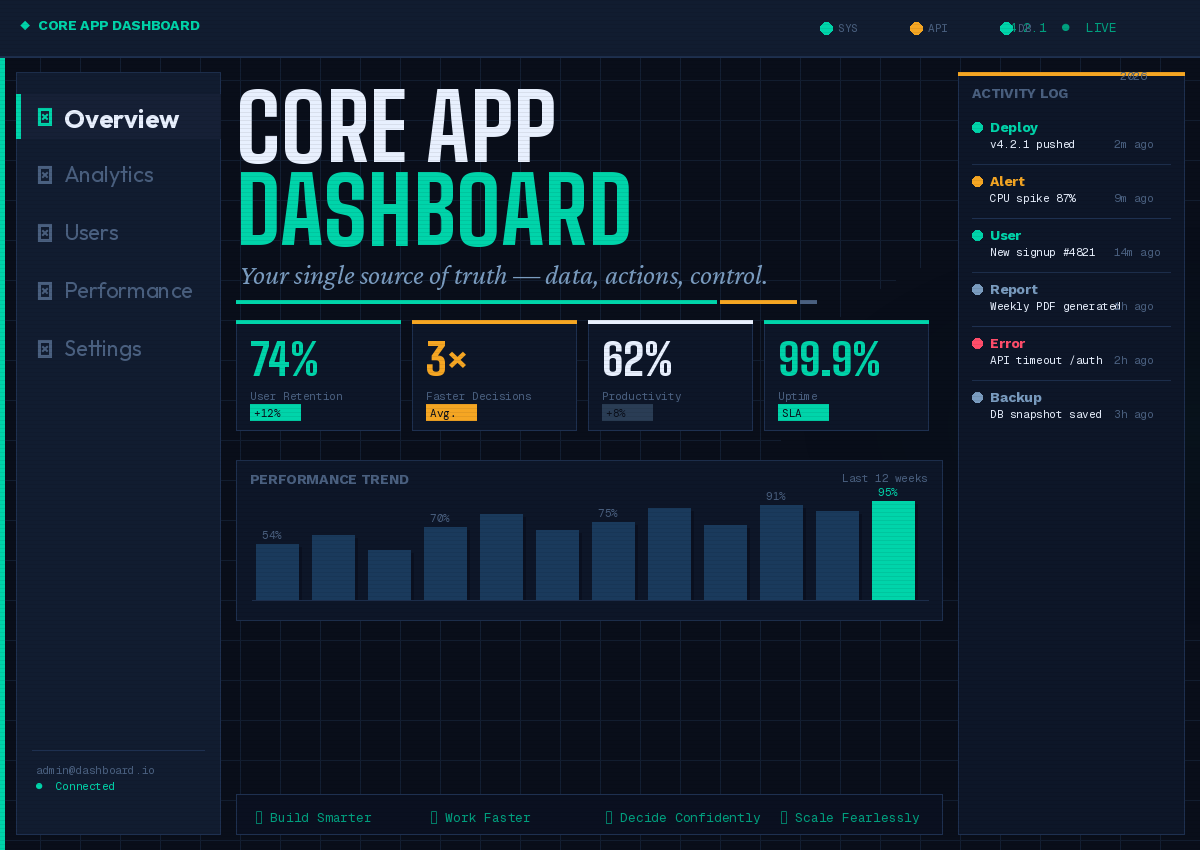
In today’s fast-paced digital landscape, teams and individuals juggle dozens of tools, metrics, and workflows simultaneously. A well-designed core app dashboard acts as the central nervous system of any application — giving users instant access to the data, tasks, and controls that matter most. Without it, productivity suffers and confusion reigns.
Whether you’re a product manager overseeing feature launches, a developer monitoring application health, or a business owner tracking KPIs, the core app dashboard is your single source of truth. It transforms raw data into actionable intelligence, helping you make faster, smarter decisions without context-switching across multiple platforms.
This guide explores what a core app dashboard truly is, why it matters, the essential components that define it, and how to design one that users will actually love. We’ll also answer the most frequently asked questions to give you a complete, expert-level understanding of this foundational interface element.
74%of users abandon apps lacking a clear dashboard
3×faster decision-making with unified dashboards
62%productivity gain from real-time data visibility
What Is a Core App Dashboard?
A core app dashboard is the primary interface screen within a software application that consolidates and displays the most critical information, tools, and navigation options a user needs. It serves as the first and most frequently visited screen, functioning like a mission control panel for your app experience.
Unlike generic reporting screens, a core dashboard is deeply personalized and context-driven. It surfaces the right data for the right user at the right time. Think of Google Analytics’ home screen, Slack’s sidebar, or Shopify’s admin overview — each is a carefully curated dashboard built around the user’s primary goals and daily workflows.
At its heart, a core app dashboard bridges the gap between complexity and clarity. It doesn’t overwhelm users with every available metric. Instead, it presents a curated, hierarchical view of information that enables quick comprehension, faster action, and reduced cognitive load throughout the working day.
A great dashboard doesn’t show everything — it shows the right thing, to the right person, at exactly the right moment.
Why Your Core App Dashboard Is Mission-Critical
First impressions in software are decisive. Research consistently shows that users form an opinion about an app within the first few seconds of interaction. A powerful, intuitive core app dashboard creates immediate trust and signals that the product understands the user’s needs. It sets the tone for every subsequent interaction.
Beyond first impressions, dashboards directly influence user retention. When users can immediately see value — their progress, their alerts, their next actions — they are far more likely to return. A cluttered or confusing dashboard, on the other hand, leads to churn. The dashboard is where engagement is won or lost on a daily basis.
From a business perspective, a well-built core dashboard reduces support overhead significantly. When key information is accessible without training or documentation, users self-serve more effectively. This translates into lower customer support costs, higher NPS scores, and a competitive advantage that compounds over time as users grow more proficient.
Essential Components of a High-Performance Dashboard
Not all dashboards are created equal. The most effective core app dashboards share a consistent anatomy of well-chosen components, each serving a distinct purpose. Understanding these building blocks is the first step toward designing an interface that genuinely empowers users.
- KPI Summary Cards — Top-line metrics displayed prominently with visual indicators (up/down trends, percentage changes) that give users an immediate health-check of their most important numbers at a glance.
- Navigation & Quick Actions — A persistent sidebar or top-bar providing access to all major sections, plus shortcut buttons for the most frequent tasks, reducing clicks and streamlining daily workflows.
- Real-Time Data Feeds & Charts — Live or near-live visualizations including line graphs, bar charts, and activity logs that let users monitor performance trends and anomalies as they happen.
- Alerts & Notification Center — A dedicated area surfacing urgent items, system warnings, or task reminders so that nothing critical falls through the cracks during a busy workday.
- Personalization Controls — Widget management, theme settings, and layout customization options that allow each user to tailor the dashboard to their individual role and workflow preferences.
Human-Centered Design Principles for Core Dashboards
The best core app dashboards are designed with empathy, not just engineering. Human-centered design (HCD) places the user’s mental model, goals, and frustrations at the forefront of every decision. Before writing a single line of code, teams should conduct user interviews, journey mapping, and task analysis to understand what truly matters to their audience.
Progressive disclosure is a powerful HCD principle especially relevant to dashboards. Rather than presenting all information at once, effective dashboards reveal details incrementally — a summary on the surface, with drill-down capability for those who need it. This balances simplicity for casual users with depth for power users, satisfying both without compromise.
Visual hierarchy is equally important. The eye naturally moves from large to small, bright to muted, and top to bottom. Smart dashboard designers use size, color, contrast, and spacing deliberately to guide attention toward the most important elements first. A well-executed visual hierarchy ensures users extract value within seconds, even on their very first login.
Accessibility as a Core Requirement
An often-overlooked dimension of dashboard design is accessibility. A truly great core app dashboard is usable by people with visual impairments, motor disabilities, or cognitive differences. This means using sufficient color contrast, supporting keyboard navigation, providing screen-reader-compatible labels, and avoiding information conveyed solely through color. Inclusive design is not an afterthought — it is excellence.
Dashboard Performance: Speed and Scalability
A dashboard that loads slowly destroys its own value proposition. If users must wait more than two seconds for data to render, they lose confidence in the tool. Performance optimization — through lazy loading, data caching, API response compression, and skeleton screens — is as important as the visual design of the core app dashboard itself.
Scalability is the long-term counterpart to performance. As your user base grows and data volumes expand, your dashboard must remain fast and reliable. Architectural choices made early — such as using paginated queries, indexed databases, and efficient state management — determine whether your dashboard stays snappy at ten users or ten million users.
Monitoring your dashboard’s own health is a virtuous practice. Embedding performance metrics — like load time percentiles, error rates, and API latency — directly into your internal core dashboard creates a feedback loop that keeps your engineering team accountable and your users consistently satisfied with the experience you deliver.
Common Mistakes That Undermine Core Dashboards
The most common dashboard failure is information overload. In an attempt to show value, teams pile in every available metric, creating a cluttered, overwhelming experience. The solution is ruthless prioritization — ask not “what can we show?” but “what does the user absolutely need to see right now?” Restraint is a design skill.
Another critical mistake is designing a one-size-fits-all dashboard for a diverse user base. A sales rep, a developer, and a finance analyst all have radically different priorities. Role-based dashboards — or deeply customizable layouts — ensure each user sees a view optimized for their specific context, dramatically increasing relevance and daily engagement with the product.
Ignoring mobile responsiveness is also a costly oversight. With more professionals accessing dashboards on tablets and smartphones, a core app dashboard must adapt gracefully to smaller screens. This means rethinking layouts for vertical scrolling, using touch-friendly controls, and prioritizing the single most important metric on constrained screen real estate.
Further Reading & Authoritative Sources
To deepen your understanding of core app dashboard design and best practices, the following authoritative resources provide research-backed insights, expert guidelines, and practical frameworks used by top product teams worldwide.
- Nielsen Norman Group — Dashboards & Preattentive Visual Processing The world’s leading UX authority explains how to use color, shape, and spatial grouping to make dashboard data instantly readable.
- Smashing Magazine — From Good to Great in Dashboard Design An in-depth guide on research methods, decluttering strategies, and data visualization techniques for building high-quality dashboards.
- Nielsen Norman Group — 8 Design Guidelines for Complex Applications Eight evidence-based UX guidelines specifically for complex app interfaces, including real-time dashboards and enterprise tools.
- InsightSoftware — A UX Roadmap for Effective Dashboard Design A practical UX roadmap covering cognitive load, widget management, and how to balance depth with simplicity in dashboard interfaces.
- NocoBase — Top 6 Core App Dashboard Building Tools A comprehensive comparison of leading tools — including Power BI, Looker, and NocoBase — for building and managing core app dashboards.
CONCLUSION
A well-crafted core app dashboard is not merely a feature — it is the foundation of your entire user experience. It shapes how users perceive your product’s value, determines how efficiently they work, and ultimately drives long-term retention and advocacy. Investing in dashboard design is investing in your product’s success.
Focus on clarity over comprehensiveness. Prioritize speed and accessibility alongside aesthetics. Let user research, not assumptions, guide which metrics and tools earn prominent placement. When your core app dashboard truly reflects the needs of the people using it, everything else in your product becomes easier to navigate, understand, and love.
Start by auditing your current dashboard with real users. Identify the three things they check first — and make those three things impossible to miss. Great dashboards are built one intentional decision at a time.
Frequently Asked Questions
Q1. What is the primary purpose of a core app dashboard?
A core app dashboard centralizes the most critical data, tools, and navigation for a user in one place, enabling faster decision-making and reducing the need to switch between multiple screens or applications throughout the day.
Q2. How many widgets or metrics should a core dashboard display?
Best practice is to limit the main view to 5–9 key elements, aligned with Miller’s Law on cognitive load. Prioritize the metrics your users check daily and provide drill-down access to secondary data rather than showing everything at once.
Q3. What’s the difference between a core dashboard and a reporting dashboard?
A core app dashboard is the primary operational hub users interact with daily — action-oriented and real-time. A reporting dashboard is typically used periodically for in-depth analysis and historical data review, often exported as documents or presentations.
Q4. How can I improve my existing core app dashboard without a full redesign?
Start with user session recordings and heatmaps to identify which elements get ignored. Remove or de-emphasize low-use widgets, increase the visual weight of high-priority metrics, and run A/B tests on layout changes to incrementally improve engagement and clarity.
Q5. Is it worth investing in a personalized dashboard experience?
Absolutely. Personalized dashboards significantly increase user satisfaction, daily active usage, and retention. When users control their own view, they engage more deeply with the product and report higher confidence in the decisions they make using it.
Read My More Articles: Stop Getting Rejected: High Risk Merchant Accounts!
