
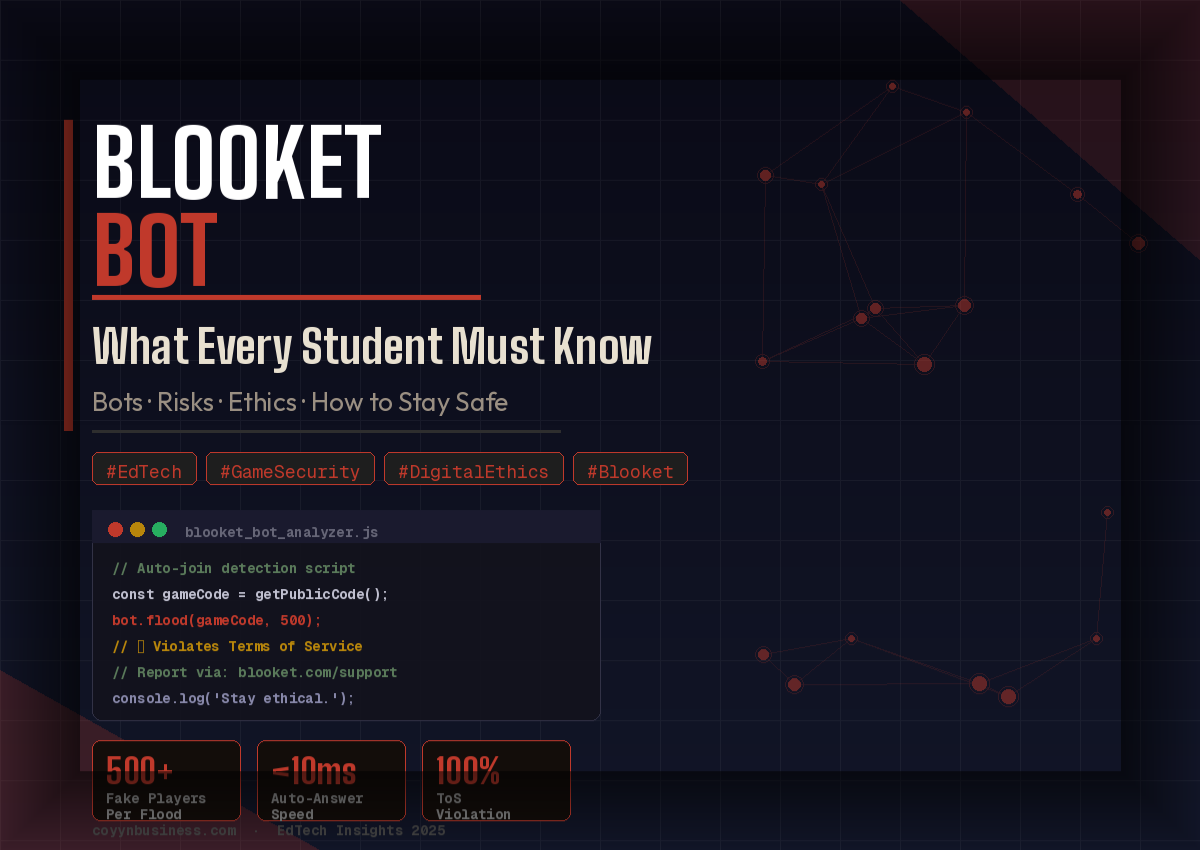
Blooket Bot is one of the most Googled phrases among students today — yet most articles only scratch the surface, ignoring the deeper educational, ethical, and technical implications that matter to teachers and learners alike.
If you have spent any time in a classroom or on an educational gaming platform recently, you have almost certainly heard of Blooket. This game-based learning tool has taken schools by storm, turning vocabulary drills and math reviews into competitive, reward-driven experiences. However, alongside its popularity, a parallel phenomenon has emerged: the Blooket Bot.
A Blooket Bot refers to any automated script, program, or tool designed to interact with the Blooket platform in an unauthorized or unintended way. This includes bots that spam a game lobby with fake players, auto-answer quiz questions, flood tokens, or manipulate leaderboards. Understanding what these bots do — and why students use them — requires a nuanced perspective that goes beyond simple condemnation.
This article offers a comprehensive, expert-level exploration of Blooket Bots: their technical basics, the psychology behind their use, their real impact on the gamified learning environment, and how educators can respond wisely. Whether you are a teacher, a student, or simply an EdTech enthusiast, this guide is for you.
1. What Exactly Is a Blooket Bot?
At its core, a Blooket Bot is an automated script — typically written in JavaScript or Python — that sends programmatic requests to the Blooket platform. These scripts exploit publicly visible game codes and the platform’s API endpoints to inject fake or automated activity into live game sessions without the host’s knowledge or consent.
The most common type is the flood bot, which joins a Blooket game with hundreds of fake usernames simultaneously. This disrupts the session, overwhelms the leaderboard, and makes it impossible for legitimate players to compete fairly. Another variant is the auto-answer bot, which uses pre-loaded answer databases to answer quiz questions faster than any human could, effectively eliminating the educational challenge entirely.
There are also token-farming bots that artificially accumulate in-game currency, and spam bots that flood the question feed or waiting room. Each type targets a different vulnerability in the Blooket game engine, and each has a distinct impact on the fairness and integrity of the learning session. Understanding their differences is the first step toward addressing them effectively.
💡 Expert Note
Most Blooket Bots are hosted on open-source repositories and require minimal coding knowledge to deploy, making them accessible to a much wider range of students than many educators realize. Awareness — not panic — is the appropriate response.
2. The Psychology Behind Why Students Use Blooket Bots
To address the Blooket Bot problem meaningfully, we must ask a question that most articles avoid: why do students use them? The answer is rarely malice. More often, it is a complex cocktail of competitive pressure, curiosity about technology, and a desire for recognition in an achievement-oriented classroom environment.
Blooket’s design is inherently competitive. Leaderboards, rare blooks, and token rewards all tap into the same psychological reward systems that make video games addictive. When students feel they cannot win legitimately — due to skill gaps, anxiety, or time pressure — the Blooket cheat bot becomes a tempting shortcut to the same social validation that top-of-the-leaderboard status provides.
Additionally, some students are genuinely curious about how the platform works. Deploying a bot is, in many ways, an act of exploratory coding — a hands-on experiment in web scripting and API interaction. This does not excuse the disruption it causes, but it does suggest that the impulse can be redirected into legitimate educational technology exploration with the right guidance from teachers and mentors. Common Sense Education’s Digital Citizenship curriculum offers excellent frameworks for exactly these conversations.
3. How Blooket Bots Work: A Technical Overview
Most Blooket Bot scripts operate by mimicking the network requests that a real browser makes when a student joins a game. Since Blooket games are identified by a publicly shared game code, a bot can join without any login credentials. The script repeatedly calls the join endpoint, generating new usernames with each iteration to create the appearance of many players entering at once.
Auto-answer bots go further. They intercept the question data returned by the server, cross-reference it with a pre-built answer key or use brute-force iteration, and submit the correct answer programmatically within milliseconds. This is possible because the answer validation logic — in some implementations — happens client-side or in ways that can be observed through standard browser developer tools, a common vulnerability in web-based quiz platforms.
It is important to note that deploying these tools may violate Blooket Terms of Service, and in some jurisdictions, unauthorized automated access to web platforms can have legal implications under computer fraud statutes. The technical elegance of these scripts does not shield users from real-world consequences, and educators should communicate this clearly to students tempted to experiment with Blooket hack tools.
4. The Real Impact on Gamified Learning Environments
The disruption caused by a Blooket flood bot is not merely inconvenient — it actively undermines the pedagogical value that makes Blooket powerful in the first place. When a classroom session is flooded with fake players or won by an auto-answer script, the formative assessment data the teacher relies on becomes completely unreliable and misleading.
Teachers use Blooket to gauge student comprehension in real time. A bot-corrupted session returns false signals: it may appear that students are answering quickly and correctly when in reality a script is doing the work. This erodes the data-driven instruction cycle that modern educators depend on, and it can lead to poor decisions about pacing, re-teaching, or intervention for struggling learners.
There is also a morale dimension. Students who work hard to prepare for a Blooket game and then watch their scores vanish beneath hundreds of bot-generated fake names experience genuine frustration and demotivation. Over time, repeated bot disruptions can erode student trust in the fairness of digital learning tools, creating a cynicism toward EdTech that is difficult to reverse.
5. What Blooket Is Doing — and What Educators Can Do Right Now
Blooket’s development team is aware of bot activity and has implemented several countermeasures over time, including rate limiting, CAPTCHA-style challenges, and enhanced server-side validation. The platform continues to update its defenses in response to new bot variants, reflecting the classic cat-and-mouse dynamic between platform security teams and the open-source bot development community.
For educators, the most practical immediate defense is to use Blooket’s password-protected game feature, which requires participants to enter a teacher-set password before joining. This single step eliminates the vast majority of bot flooding, since bots relying on public game codes cannot bypass a password barrier without additional, targeted effort.
Beyond technical fixes, the deeper solution is cultural. Educators who explicitly discuss digital ethics, explain the consequences of using Blooket bots, and redirect curious students toward legitimate coding projects report far fewer disruptions. Turning the incident into a teachable moment — exploring how the bot works, why it is harmful, and how platforms defend against it — transforms a problem into one of the most engaging computer science discussions a classroom can have.
🔒 Quick Defense Checklist for Educators
Enable game passwords · Keep game links private · Monitor the player list before starting · Report suspicious activity through Blooket’s official support channel · Follow Blooket’s official blog for security updates.
6. Ethical Dimensions: Where Does Curiosity End and Misconduct Begin?
The ethical landscape around Blooket Bots is more nuanced than a simple “cheating is wrong” narrative. Students who build or deploy these scripts often occupy a grey zone: they are not hacking a bank, but they are disrupting an educational service and violating a platform’s terms. Where educators draw that line — and how they communicate it — shapes student attitudes toward digital responsibility for years to come.
A useful framework is to distinguish between exploration and disruption. A student who reverse-engineers a Blooket game to understand how the API works, without actually deploying the tool in a live classroom, is demonstrating genuine technical curiosity. A student who floods a peer’s study session with fake players to sabotage their score is causing real harm.
These two cases deserve different responses from educators and administrators. Students eager to explore digital tools responsibly might also benefit from legitimate learning resources — for instance, this in-depth guide on Anna’s Archive is a great example of how curiosity about digital platforms can be channeled productively.
The rise of Blooket Bot use is ultimately a mirror held up to our broader educational values. If students feel that the only reward worth having is the one at the top of the leaderboard, we have perhaps over-emphasized competition at the expense of collaboration and genuine understanding. The best EdTech tools — including Blooket at its finest — should inspire learning, not just winning.
Conclusion
The phenomenon of the Blooket Bot is a symptom of a broader tension in gamified education: the gap between what motivates students and what actually helps them learn. Bots that flood lobbies, auto-answer questions, or farm tokens may feel like clever shortcuts, but they hollow out the very experience they appear to win.
For educators, the key takeaways are clear: protect your sessions with passwords, use bot incidents as teachable moments, and stay informed about platform updates. For students curious about how these tools work, channel that energy into legitimate coding projects — the skills are real and valuable; the application matters enormously.
Blooket remains one of the most effective gamified learning platforms available today. With awareness, proactive security habits, and honest classroom conversations, the disruptive potential of Blooket Bots can be minimized — and the genuine educational power of the platform can shine through for every student.
Frequently Asked Questions
1. What is a Blooket Bot?
A Blooket Bot is an automated script that interacts with the Blooket platform in unauthorized ways, such as flooding a game with fake players, auto-answering questions, or artificially accumulating in-game tokens without legitimate gameplay.
2. Is using a Blooket Bot cheating?
Yes. Using a Blooket Bot violates the platform’s Terms of Service and undermines fair play. It can also compromise the validity of classroom assessment data that teachers use for instructional decisions.
3. How can teachers prevent Blooket Bots from disrupting their games?
The most effective defense is enabling Blooket’s password-protection feature before starting a game session. This prevents bots that rely on public game codes from joining the session without authorization.
4. Can a student get in trouble for using a Blooket Bot?
Depending on the context, consequences can range from school disciplinary action to account bans on Blooket. In some jurisdictions, unauthorized automated access to web services may also raise legal concerns under computer fraud laws.
5. Are there any legitimate uses for Blooket automation tools?
Educators and developers can use Blooket’s official API or approved integrations for legitimate purposes like content creation. Any automation that disrupts live game sessions or manipulates scores, however, remains outside the bounds of acceptable use.
