
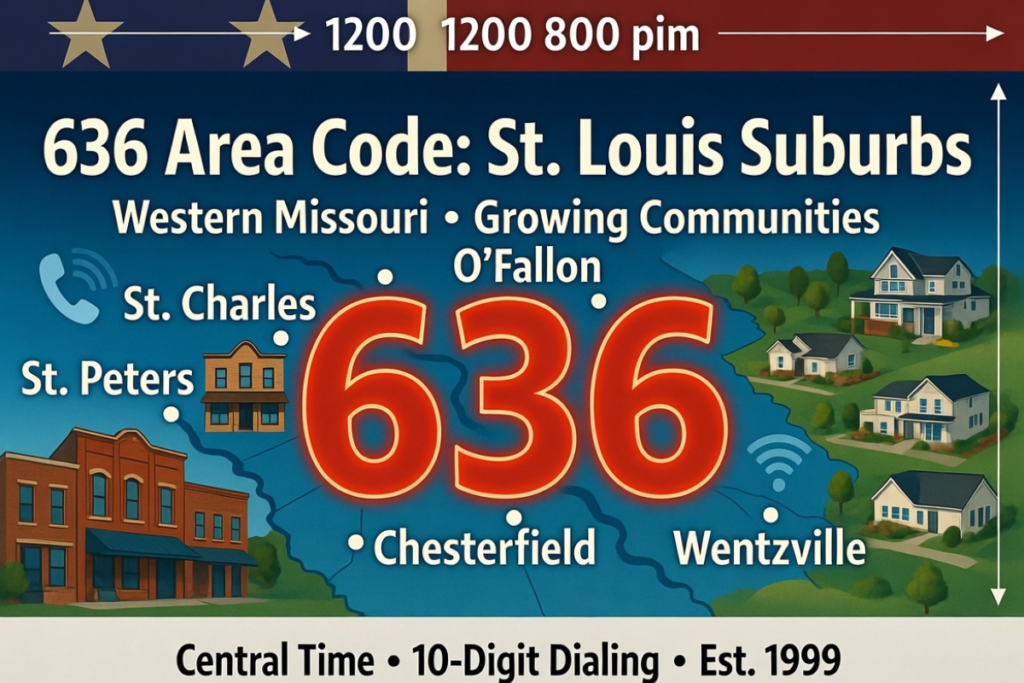
Ever spotted a “636” pop up on your phone and wondered where the call came from? You’re not alone! That little three-digit code carries a surprisingly fun story, and it’s all about Missouri’s lively western St. Louis suburbs. From historic Main Streets to booming new neighborhoods, the 636 zone covers a region that’s growing fast and full of life.
In this guide, we’ll walk you through everything you need to know about the 636 area code—where it sits, which cities it covers, what time zone it follows, and why you now have to dial all ten digits. We’ve packed in real, verified facts too, including details straight from the Missouri Public Service Commission, so you can trust every tidbit you read here. Whether you’re a curious caller, a local resident, or a business owner eyeing a new number, you’ll find clear answers and handy tips along the way. Ready to become a 636 expert? Let’s dive in!
Where Is the 636 Area Code Located?
The 636 area code covers the western suburbs of St. Louis, Missouri. It mainly serves St. Charles County and parts of western St. Louis County. So if a 636 number lights up your screen, someone in the St. Louis metro area is reaching out.
This region sits right next to the city of St. Louis, but it has its own flavor. Think growing suburbs, busy commuter towns, and family-friendly neighborhoods. The 636 zone is the heart of the metro’s expanding edge.
Here’s a quick fact to impress your friends: Missouri has nine area codes in total, according to the Missouri Public Service Commission (psc.mo.gov). The 636 is just one piece of that statewide puzzle, but it’s a busy one.
Which Cities and Towns Use the 636 Area Code?
The 636 area code includes O’Fallon, St. Charles, St. Peters, Chesterfield, and Wentzville. These are some of the fastest-growing communities in the St. Louis region. Plenty of smaller towns share the code too.
Let’s meet a few of the headliners:
- St. Charles — One of Missouri’s oldest towns, with a charming historic Main Street that locals love.
- O’Fallon — A booming suburb known for parks, family living, and a strong sense of community.
- St. Peters — A friendly city packed with shops, lakes, and recreation spots.
- Chesterfield — Home to the Spirit of St. Louis Airport and a popular shopping outlet scene.
- Wentzville — A rising star on the western edge, growing fast thanks to manufacturing and new housing.
Smaller communities like Dittmer and others scattered across the area also fall under 636. So the code stretches across a wide mix of urban, suburban, and semi-rural spots.
What Time Zone Does the 636 Area Code Use?
The 636 area code runs on Central Time (CT). That’s Central Standard Time in winter and Central Daylight Time in summer. Missouri sits squarely in the Central zone, no exceptions.
Why does this matter? If you’re calling a 636 number from another part of the country, timing is everything. Nobody wants to ring a business at 7 a.m. their time when it’s only 5 a.m. in Missouri!
Quick tip: Central Time is one hour behind Eastern and two hours ahead of Pacific. Jot that down before you dial, and you’ll always catch folks at the right moment.
When Did the 636 Area Code Start?
The 636 area code launched in 1999. It was created as a split from the 314 area code, which originally covered the entire St. Louis region. As the suburbs grew, the area needed more phone numbers.
Picture the late 1990s. Cell phones were taking off, fax machines were everywhere, and households often had two or three lines. The demand for fresh numbers exploded.
So the phone planners carved out the western suburbs and gave them their own shiny new code: 636. It was a smart move that gave the growing region room to breathe.
How Many Phone Numbers Does the 636 Area Code Hold?
Each area code, including 636, holds about 7.9 million phone numbers. That figure comes straight from the Missouri Public Service Commission. It’s a huge pool, but it’s not endless.
Here’s how the math works. Every area code has 792 prefixes available for public use, and each prefix is a block of 10,000 numbers. Multiply those out and you get that big 7.9 million total.
But wait, not every number is up for grabs. Some get reserved for special uses, like 911, 711, and 411. Those little exceptions keep the emergency and info lines running smoothly.
When Will the 636 Area Code Run Out of Numbers?
The 636 area code is expected to run out of numbers in the third quarter of 2075. That’s the official “exhaust date” listed by the Missouri Public Service Commission. So there’s no shortage anytime soon!
Compare that to other Missouri codes. The 417 area code is set to exhaust by the second quarter of 2032, much sooner than 636. Meanwhile, the 660 code won’t run dry until 2103.
Why does 636 have such a long runway? Smart number conservation efforts help a lot. Practices like number pooling and reclamation stretch the supply so the region stays well-stocked for decades.
Do You Have to Dial 10 Digits for the 636 Area Code?
Yes, you need to dial all 10 digits for calls in and around the 636 area code. That means the area code plus the seven-digit number, every single time. Seven-digit dialing is a thing of the past.
This shift ties back to a national change. In 2020, the FCC set up 988 as the three-digit Suicide and Crisis Lifeline. To make room for that code, many regions had to drop seven-digit local dialing.
So even when you call your neighbor across the street, punch in the full number. It feels like extra work at first, but you’ll get used to it fast. Your fingers will thank you for the muscle memory!
Is the 636 Area Code an Overlay or a Standalone Code?
Right now, 636 is a standalone area code, not part of an overlay. An overlay is when two codes share the same geographic region. The 636 area still covers its own turf solo.
This sets it apart from some Missouri neighbors. The 314 area code, for example, now shares its region with the new 557 overlay. The 816 code teamed up with 975, and 573 paired with 235.
Since 636 has plenty of numbers until 2075, it doesn’t need a partner code yet. That keeps things simple for everyone in the western St. Louis suburbs.
Why Is the 636 Area Code Important for Businesses?
A 636 number signals strong local roots in the St. Louis suburbs. For businesses, that local presence builds trust with nearby customers. People are more likely to answer a call that looks familiar.
Think about it from a customer’s view. Would you rather pick up a random out-of-state number or one that matches your own area? Most folks lean toward the local one every time.
Here are a few smart business reasons to grab a 636 number:
- Local credibility — You look like a true part of the community, not a faraway outsider.
- Higher answer rates — Familiar codes get more pickups and fewer ignored calls.
- Marketing trust — A local number on your ads and website feels approachable and real.
- Easy expansion — Virtual phone services let you snag a 636 number even if your office is elsewhere.
For shops in St. Charles or service pros in O’Fallon, a 636 line is a quiet but powerful trust signal. It tells customers, “Hey, we’re right here in your neighborhood!”
How Can You Get a 636 Area Code Phone Number?
Getting a 636 number is easier than ever. You can request one through your local phone carrier or a virtual phone service. Many providers let you choose a 636 prefix during setup.
For traditional landlines, just contact a Missouri-based carrier and ask for a number in the 636 region. They’ll check availability and assign one to your line.
Prefer something more flexible? Virtual and VoIP services are a fantastic option. They let remote teams and small businesses pick a 636 number without ever setting foot in Missouri. Handy, right?
How Do You Spot a Scam Call From the 636 Area Code?
Not every 636 call is friendly, sadly. Scammers sometimes “spoof” local codes to seem trustworthy. So treat unexpected 636 calls with a healthy dose of caution.
Here are some red flags to watch for:
- The caller demands money or personal info right away.
- They pressure you to act fast or “or else.”
- The number looks local but the story sounds off.
When in doubt, hang up and call the official number of the company yourself. Never share bank details or passwords over a surprise call. A little caution keeps your wallet and your peace of mind safe.
Quick Facts About the 636 Area Code
Let’s round up the highlights in one handy list:
- Location: Western St. Louis County and St. Charles County, Missouri.
- Major cities: O’Fallon, St. Charles, St. Peters, Chesterfield, Wentzville.
- Created: 1999, as a split from the 314 area code.
- Time zone: Central Time.
- Number capacity: About 7.9 million numbers.
- Exhaust date: Third quarter of 2075.
- Dialing rule: 10-digit dialing required.
- Status: Standalone code, no overlay yet.
Bookmark these, and you’ll be the 636 expert in any room!
Frequently Asked Questions
Where is the 636 area code?
It covers western St. Louis County and St. Charles County in Missouri, including suburbs like O’Fallon and St. Charles.
What cities use the 636 area code?
O’Fallon, St. Charles, St. Peters, Chesterfield, and Wentzville are the main ones, plus several smaller towns.
What time zone is the 636 area code in?
Central Time, which is one hour behind Eastern and two hours ahead of Pacific.
When was the 636 area code created?
It launched in 1999 as a split from the original 314 area code.
How many numbers does the 636 area code have?
About 7.9 million, based on Missouri Public Service Commission data.
When will 636 run out of numbers?
The official exhaust date is the third quarter of 2075, so plenty of time left.
Do I need to dial 10 digits for 636 calls?
Yes, you must dial the full 10-digit number for every call.
Is 636 a standalone or overlay area code?
It’s currently a standalone code with no overlay partner.
Is the 636 area code a scam?
No, it’s a legit Missouri code. But scammers can spoof any code, so stay alert with unexpected calls.
Can I get a 636 number if I live outside Missouri?
Absolutely! Virtual and VoIP phone services let you grab a 636 number from anywhere.
Final Thoughts on the 636 Area Code
The 636 area code is more than just three digits. It represents the lively, growing suburbs west of St. Louis, from historic St. Charles to booming Wentzville. With numbers lasting until 2075 and no overlay needed yet, this code is in great shape.
Whether you’re answering a call, starting a business, or just curious, you now know the full 636 story. So the next time that code flashes on your screen, you’ll smile and think, “Ah, the St. Louis suburbs are calling!”
Read More: 856 Area Code: Location, Cities & Facts You Should Know